The Data Silo Problem
Most businesses suffer from data fragmentation. Customer data lives in the CRM, financial data in the ERP, marketing data in various platforms, and operational data in specialized systems. This fragmentation prevents organizations from seeing the complete picture.
Effective data integration breaks down these silos, creating a unified view that enables better decision-making across the organization.
Data Integration Approaches
Extract, Transform, Load (ETL)
Traditional approach where data is extracted from sources, transformed to a common format, and loaded into a target system.
Best for:
- Batch processing
- Well-defined data sources
- Data warehouse populations
Extract, Load, Transform (ELT)
Data is extracted and loaded first, then transformed within the target system. Modern approach leveraging cloud computing power.
Best for:
- Large data volumes
- Cloud-based architectures
- Exploratory analytics
Real-Time Integration
Data flows between systems as events occur, enabling immediate synchronization.
Best for:
- Operational processes requiring current data
- Event-driven architectures
- Customer-facing applications
API Integration
Systems communicate through defined interfaces, exchanging data on demand.
Best for:
- Application interconnection
- SaaS integrations
- Mobile and web applications
Designing Your Integration Architecture
Data Inventory
Start by cataloging:
- What data exists across the organization?
- Where does it live?
- Who owns it?
- How is it created and updated?
Integration Requirements
For each integration need, define:
- Source and target systems
- Data elements to integrate
- Frequency requirements
- Quality requirements
- Security requirements
Architecture Decisions
Key choices include:
- Centralized vs. decentralized integration
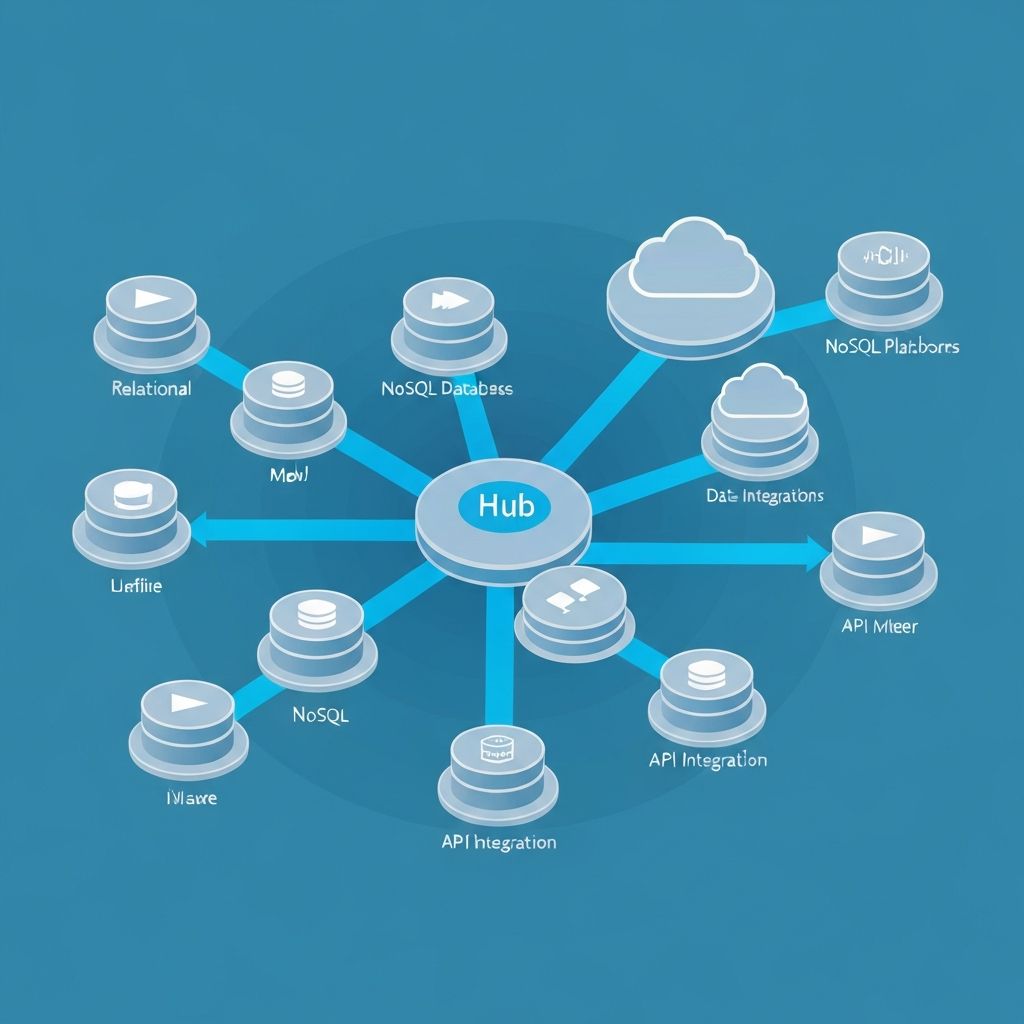
- Point-to-point vs. hub-and-spoke patterns
- Batch vs. real-time processing
- Build vs. buy
Data Quality Considerations
Integration is only valuable if the data is trustworthy.
Data Validation
Implement checks at integration points:
- Format validation
- Referential integrity
- Business rule compliance
- Completeness checks
Data Standardization
Create common definitions for:
- Entity identifiers
- Date formats
- Code values
- Naming conventions
Master Data Management
Establish authoritative sources for key entities:
- Customer master
- Product master
- Vendor master
- Location master
Security and Compliance
Data integration creates new security considerations:
- Data in transit protection
- Access control at integration points
- Audit logging
- Compliance with data residency requirements
- Privacy regulation compliance
Common Integration Challenges
Data Quality Issues
Garbage in, garbage out. Address quality at the source before integrating.
Schema Evolution
Systems change over time. Build integrations that handle change gracefully.
Performance
Large data volumes can strain systems. Plan for peak loads and growth.
Complexity
Every integration adds complexity. Balance the value of integration against maintenance burden.
Need help designing and implementing data integration solutions? DEV IT SOLUTIONS provides comprehensive data integration services, from strategy development to implementation and ongoing management.